Our Contributions to CO2 Reduction across Society
Basic Approach
The PARK24 GROUP is playing a pivotal role in the development of a circular economy through its parking and mobility businesses. We generate both economic and social value by sharing our business capital, including both land and vehicles. We visualize the positive social impact of the PARK24 GROUP's circular economy business model by quantifying our contribution to the reduction of total CO2 emissions across the whole of society. We also take steps to maximize our contribution, such as through collaboration between our services and public transportation providers.
Overview of CO2 Reduction Contributions by PARK24 GROUP Businesses
The PARK24 GROUP is using the life cycle assessment (LCA) approach to calculate contributions to emission reductions in relation to the manufacture and use of the vehicles and equipment required for our services. We have completed our calculations for areas relating to manufacturing for our Mobility Business and usage for our parking business.
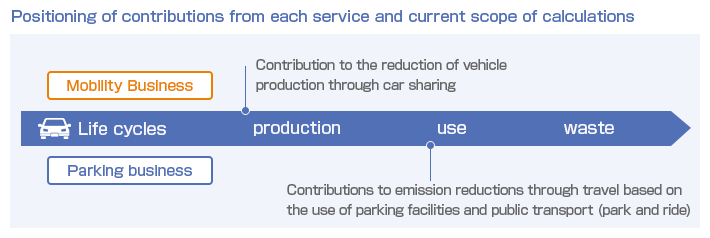
Contribution from the Mobility Business
Contribution to CO2 Emissions Reduction Across Society via Times CAR Mobility Service
By encouraging individuals or corporations to use Times CAR vehicles instead of owned vehicles for their transportation needs, we contribute to the reduction of CO2 emissions by our customers and society in general. We calculate our contribution through comparisons based on scenarios in which Times CAR exists or does not exist.
Calculation Method
We estimated the reduction effect in environmental impact through the Times CAR service, excluding rental cars, based on a Times CAR member survey of transportation behaviour and usage data (*1). We found that one Times CAR vehicle meets travel demand equivalent to 16 privately owned vehicles (*2). We define this as the "mobility demand allocation efficiency" of owned vehicles. To calculate the contribution per vehicle, we multiply this efficiency ratio by a conversion factor representing emissions resulting from the manufacture of vehicles. By multiplying the result by the number of vehicles procured in the period under review, we determine the final contribution of the overall Mobility Business in relation to manufacturing (*3).
- *1 A survey conducted by the PARK24 GROUP between 2021 and 2022 on the transportation behaviors of Times CAR members before and after joining
- *2 This includes cars owned by private citizens and corporations
- *3 Estimate based on the following responses by Times CAR members in the survey on transportation behaviors: "I got rid of my own car" and "I decided not to purchase a new car"
Calculation Formula

- * Factor A: Discount for member attributes that do not contribute to the reduction of CO2 emissions during vehicle manufacture (discount ratio calculated based on survey of transportation behavior conducted in the fiscal year ended October 2021)
- * Factor B: CO2 emitted per vehicle during manufacture (6.2 tCO2 according to IEA data)
- * Factor C: Adjustment for differences in period of use for general vehicles (10 years according to IEA data) and Times CAR vehicles (four years)
Calculation results and expansion policy
In the fiscal year ended October 2025, the expansion in the scale of each of the Group’s businesses resulted in a year-on-year increase in Scope 1–3 emissions. The contribution to emission reductions in the Mobility Business is calculated by multiplying the contribution per vehicle by the number of car sharing service vehicles procured. As the number of vehicles procured in the fiscal year ended October 2025 increased compared with the previous year, the contribution to emission reductions also increased.
The PARK24 GROUP defines its GHG impact as its total Scope 1–3 emissions minus the reduction contributions achieved through its business activities, and is working to minimize this impact.
Scope 1–3 Emissions and Reduction Contributions
| (Unit: 10,000 tCO2) |
Fiscal Year Ended October 2023 |
Fiscal Year Ended October 2024 |
Fiscal Year Ended October 2025 |
|---|---|---|---|
|
① Scope 1–3 emissions |
43 |
51 |
61 |
|
② Reduction contributions |
25 |
26 |
41 |
|
③ GHG impact (①–②) |
18 |
25 |
20 |
*The calculation results are provisional estimates at this time. These figures may change as calculation methods are refined in the future.
Calculating contributions to emission reductions in collaboration with specialist organizations
We are collaborating with research institutions and other organizations to refine the methodology for calculating the contribution to emission reductions generated by our car sharing service and to ensure its objectivity. Specifically, we have held discussions with Dr. Masaru Kumai, who holds a Ph.D. in Environmental Studies, of the Foundation for Promoting Personal Mobility and Ecological Transportation, and have received a review of the validity of both the calculation methodology and the results. In addition, through joint research with Oita University, we worked to refine an integrated calculation method that takes into account not only the vehicle life cycle—from manufacturing and use to disposal—but also substitute transportation such as public transit. Our current contribution to emission reductions is calculated by reflecting the PARK24 GROUP’s actual usage data in these research findings. In addition, several prior studies have indicated that the wider adoption of car sharing services contributes to a reduction in the number of vehicles in society, the associated reduction in CO2 emissions, and the conservation of scarce resources.
Effects of Mobility Services on Reducing Environmental Impact
Times CAR reduces CO2 emissions by 26% per kilometer traveled compared to traveling in an individually-owned car. (*1,*2)
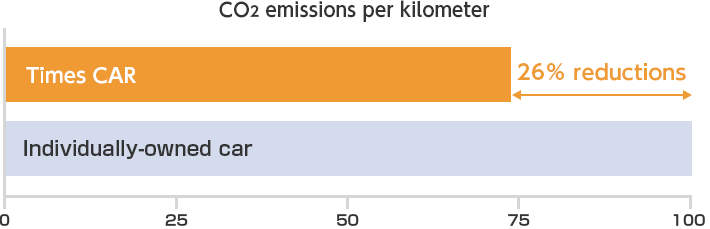
- *1 An estimate based on a simulation model that was created by combining distance distribution for a normal trip estimated from Times CAR usage data with changes in transport methods, travel distance, and car model before and after joining based on the survey of transportation behaviours. The reduction effect in CO2 emissions is the overall value of reductions in travel frequency and distance by car, reductions due to “Park and Ride”, and reductions due to fuel improvements.
- *2 The above data estimates overall Times CAR usage based on Times CAR member surveys on transportation behaviour and actual usage, and does not guarantee reductions in individual use. The above data was estimated by Park24 Co., Ltd.
Contribution from the Parking Business
Contribution to CO₂ Emissions Reduction Across Society via Times PARKING Service
Times PARKING contributes to the reduction of social CO2 emissions through park-and-ride (P&R) behavior. We used data from surveys of Times CLUB members to calculate the contribution to emission reductions per P&R cycle (round trip). We then calculated the contribution made by our parking business through the provision of parking facilities to facilitate P&R behaviour.
Calculation Method
Based on a survey conducted among Times CLUB members during the fiscal period ending October 2024, we identified the travel modes and behavioral characteristics of Park & Ride (P&R) users. Using this data, we developed a “CO2 Reduction Estimation Model” that combines a classification model and a choice model. We then applied this model to usage data from Times PARKING locations eligible for P&R, and by factoring in the Times PARKING share rate, we quantitatively estimated the CO2 emission reduction effect attributable to P&R.
Calculation Formula

Calculation results and expansion policy
We have determined that P&R behavior reduced CO2 emissions by 28 tCO2 between January 1 and December 31, 2024. We will continue to explore ways to calculate the contributions made by the parking business to the reduction of emissions.
Related SDGs